AI Solutions.
AI Solutions.
· THE AUTOMATION OF TRANSPORT PLANNING ·

Through the domain-appropriate application of AI/Machine-Learning, Transport Planning Principles, and Open Pervasive Data, the process of planning model development can be accomplished within hours instead of months.
Currently, the approach is capable of modelling virtually any city, any day.
Our aim is to model every city in the world, every day.
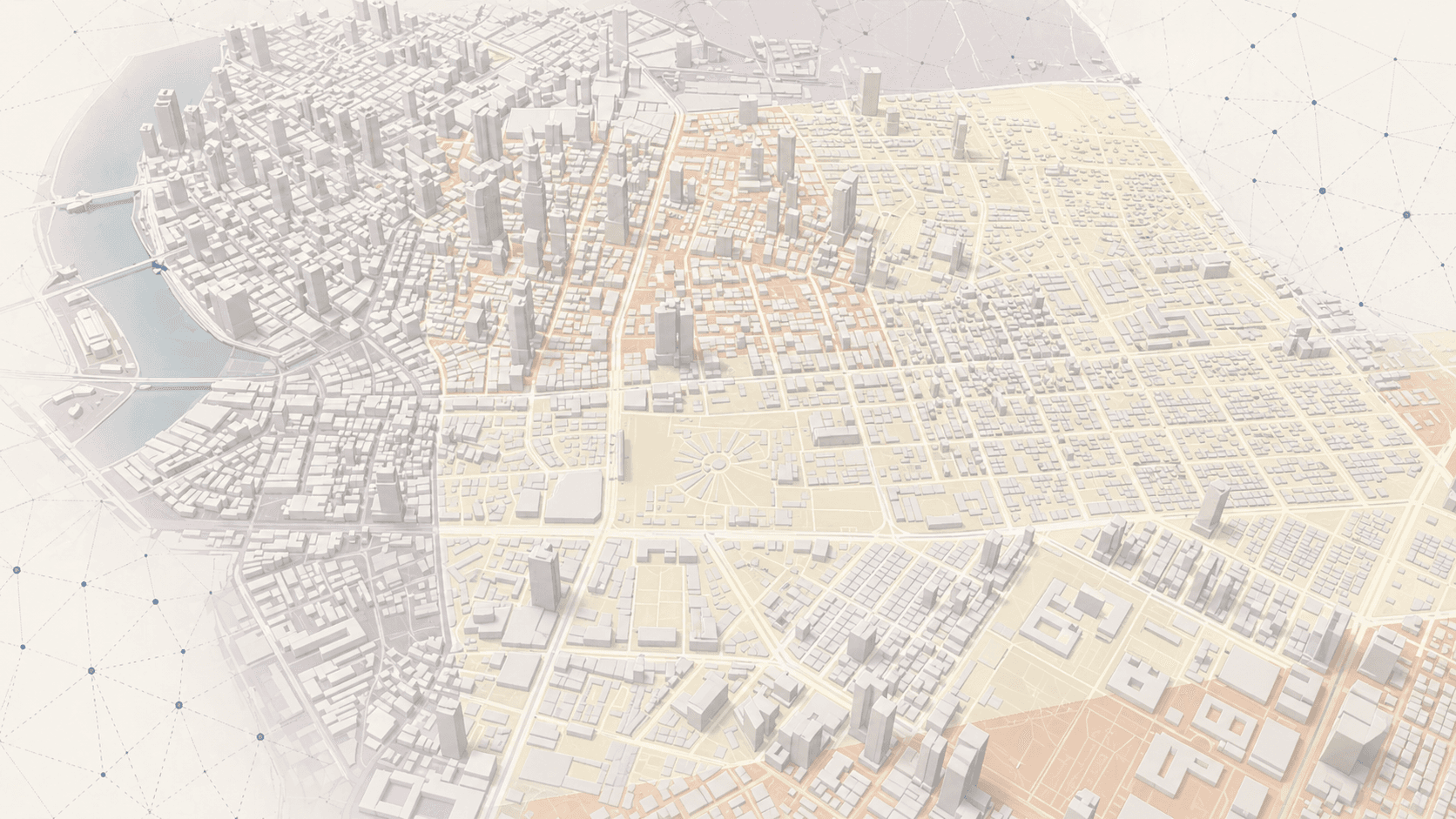
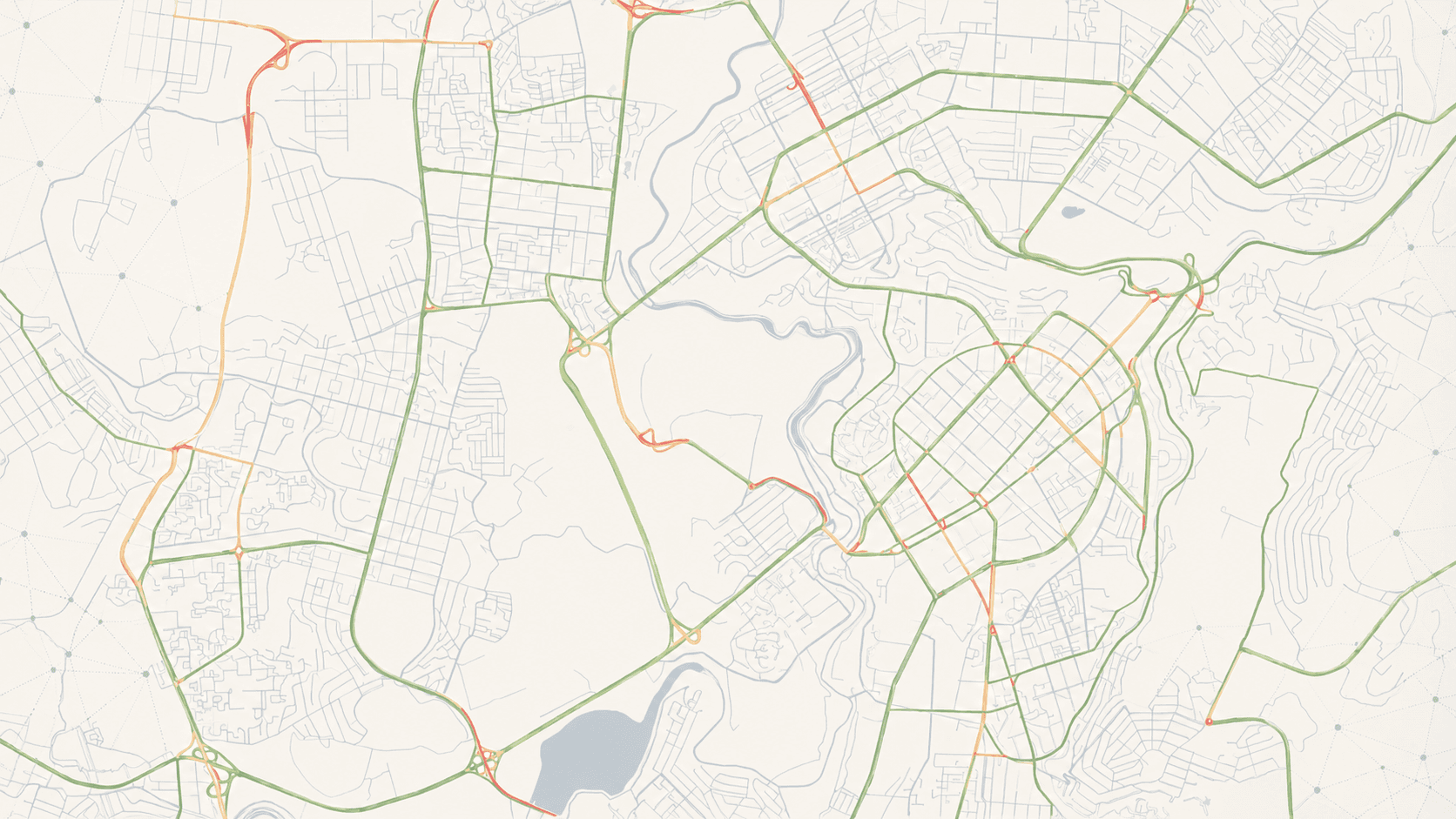
Automated Network Supply Estimation
The roadway network supply model is inferred automatically (typically within minutes) with no required human interaction.
Open data sources (such as OpenStreetMap) are automatically fetched and then processed with machine learning methods to infer network zonal structure, roadway vehicular capacities, and link performance functions without requiring human effort.
Automated Travel Demand Estimation
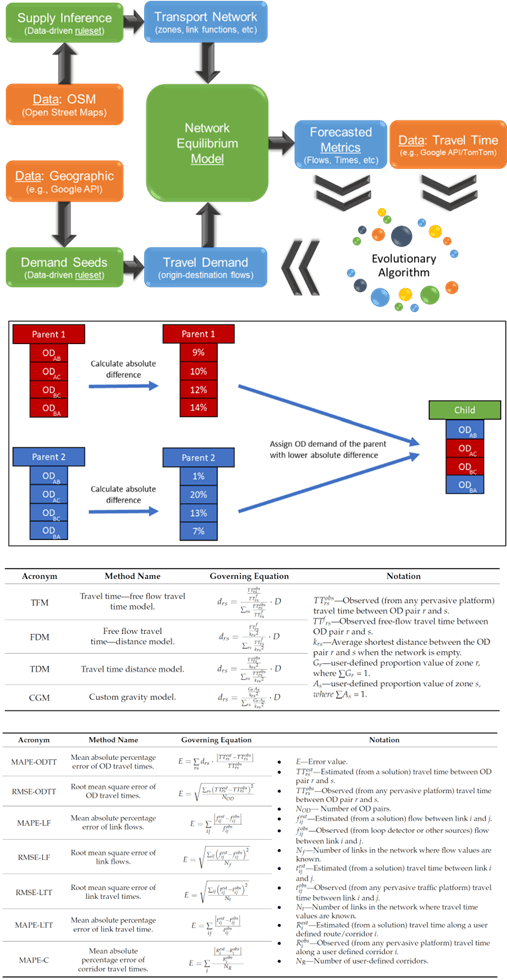
The origin-destination travel demand values are automatically estimated via evolutionary algorithms to match travel time data (fetched from any of multiple globally available data sources).
Critically, the process embeds the traditional concept of transportation demand/supply equilibrium to ensure the produced model is suitable for hypothetical transportation planning applications.
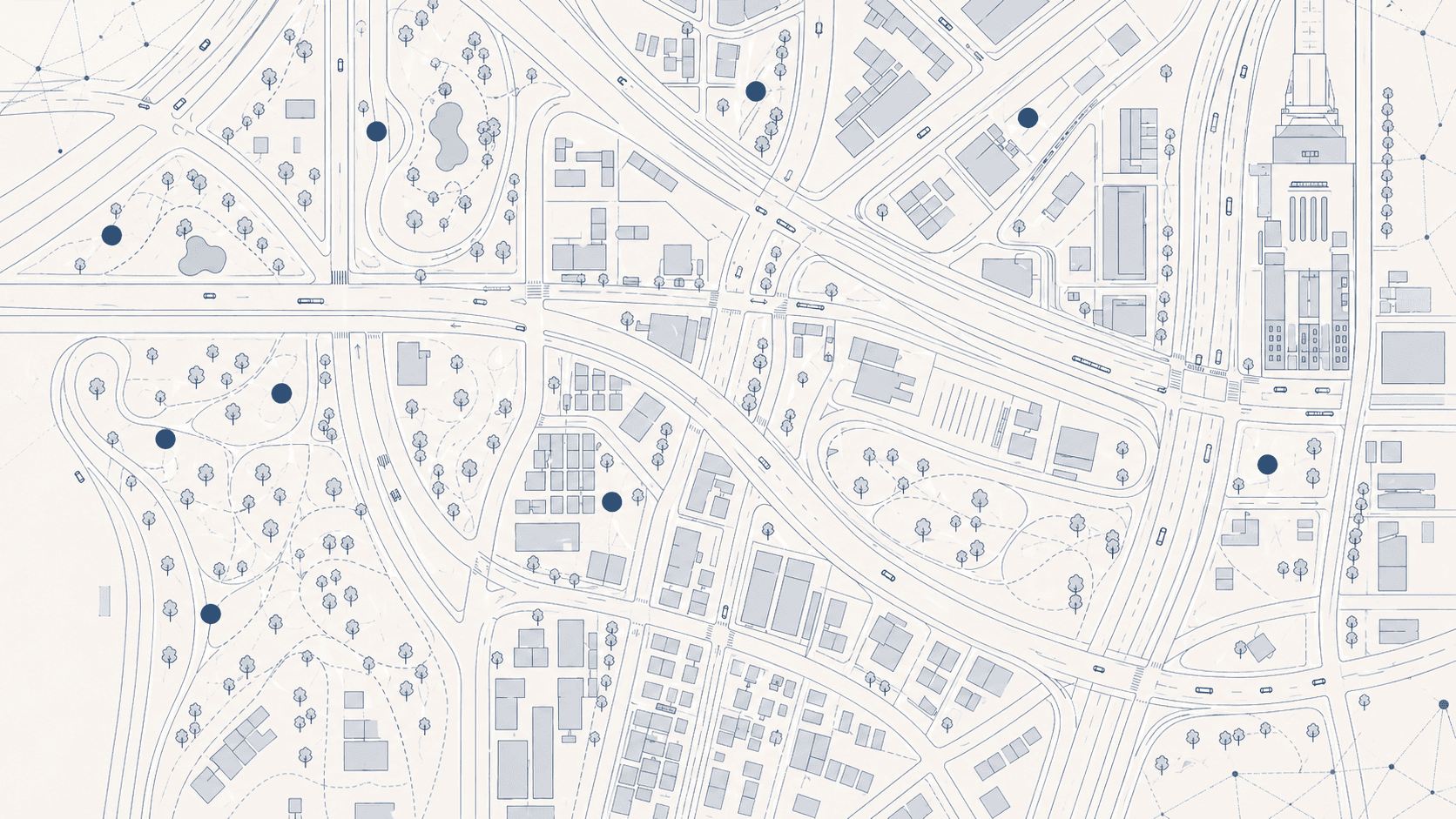
Open Source and Supported Tools
Both supported services and open-source tools have been developed.
The models generated by Automated Transport Planning are provided in fully open data formats. The models can be imported into a broad range of third-party planning software for further analysis. An example of a web-based interface that can be used to directly examine the generated data can be seen here.
Road Carbon Modelling - Sustainability
Road Carbon Modelling - Sustainability
As noted in Waller et al. (2025), by using the demand patterns, network flows and location data, current research is focusing on the quantification of broader metrics from automated planning including:
Road carbon emissions
Equity
Environmental Justice
Novel insights, such as distinct differences in regional carbon sensitivity between global cities, become apparent.
Other ongoing work includes:
Development of travel demand management scenarios across cities
Examining the impact of network structure and city design on road carbon, equity, and sustainability
Quantifying the cross-over points where differing cities change their ranking of impact across demand management scenarios
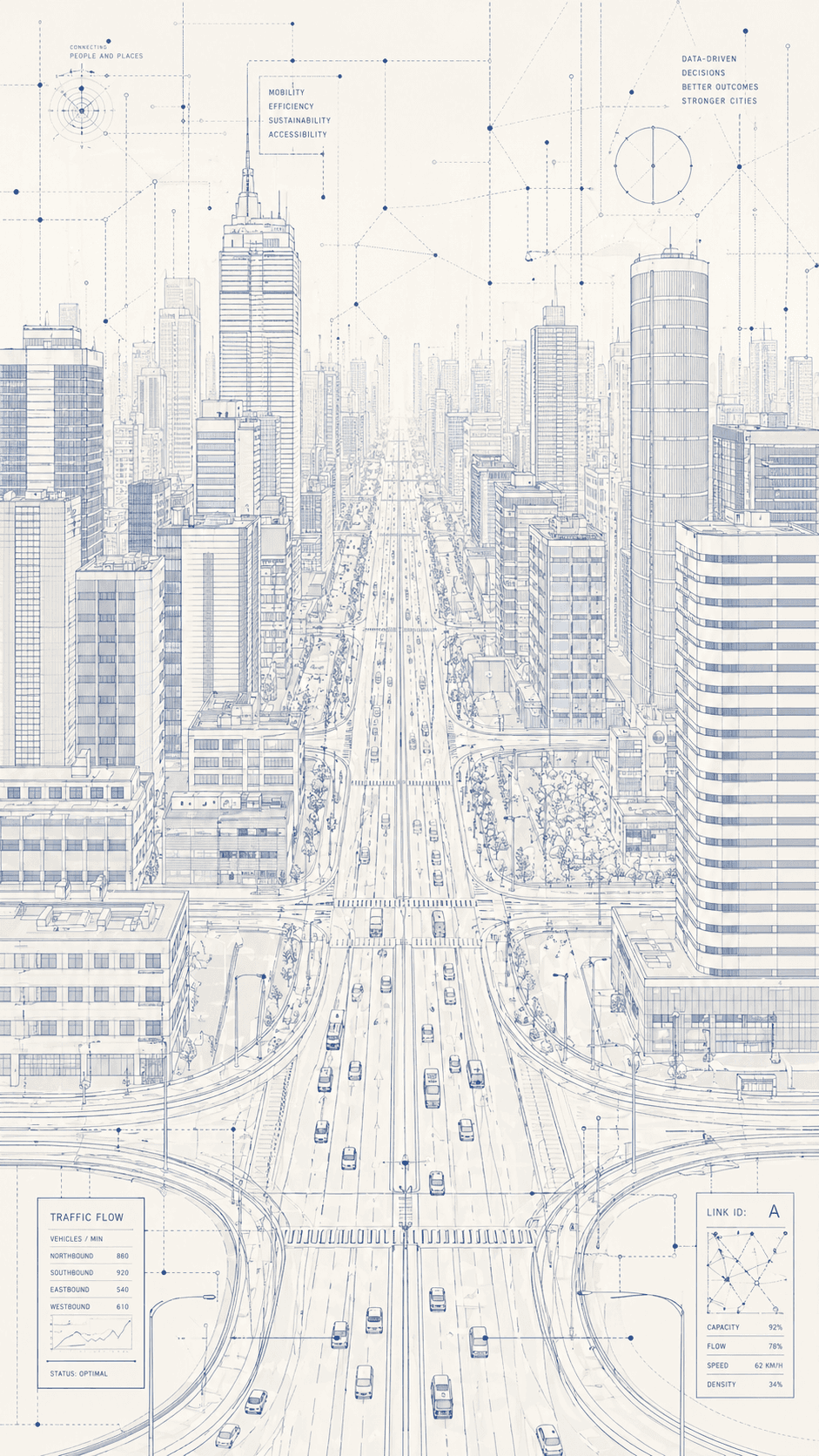
Conflict & Disasters - Resilient Cities
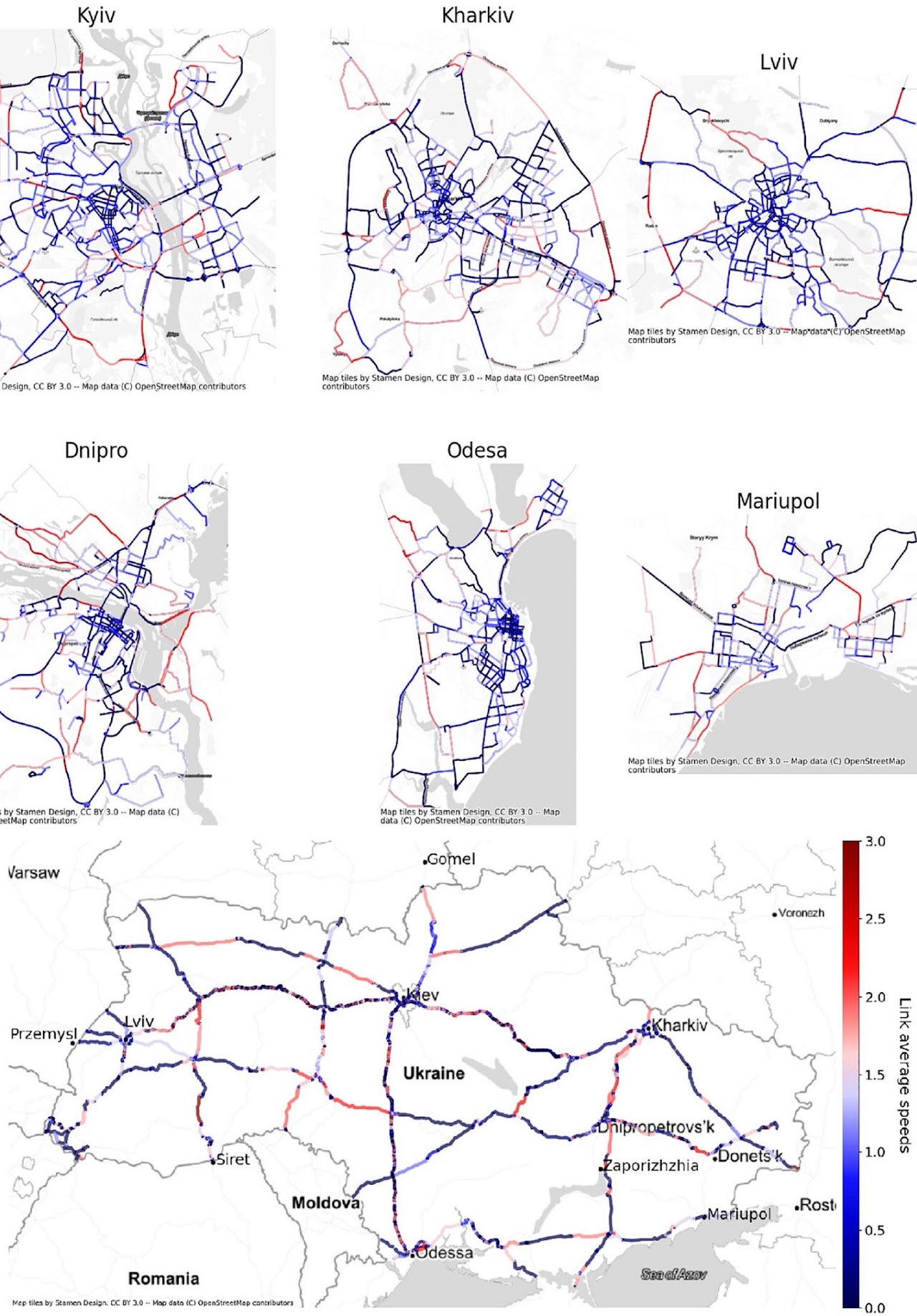
As demonstrated for the specific case of analysis during the Ukrainian conflict (in Waller et al., 2023), since the automated approach allows for the rapid development of models within hours rather than months, disaster and conflict scenarios become much more practical for analysis.
In general, the following applications are being explored via automated transport planning:
Rapid assessment of network loss to assist reconstruction planning
Development of scenarios to assist in the design of cities more resilient to natural diasasters and human conflict
NOTE: A more complete set of event data from the Ukrainian analysis can be downloaded from here.
Methodology: Blending AI with Tradition
Overview
A research team led by Professor Travis Waller developed the methodology based on 20 years of published research on transportation network modelling and Evolutionary Algorithms (EA). The specific automated transport planning methodology uses AI/Machine Learning via EA as described in the open-access, peer-reviewed journal paper Waller et al. (2021).
Principles
While Machine Learning is employed, the traditional transportation demand/supply equilibrium process is fully maintained, thereby producing models suitable for hypothetical planning analysis.
The core principle of this approach is to automate the traditional process rather than replacing any well-tested transportation planning methods with an unexplainable model or process.
Automated Planning References
ST Waller, S Chand, A Zlojutro, D Nair, C Niu, J Wang, X Zhang, and VV Dixit “Rapidex: A novel tool to estimate origin–destination trips using pervasive traffic data” Sustainability (Switzerland), vol. 13, pp. 11171 – 11171, 2021. https://doi.org/10.3390/su132011171 https://www.mdpi.com/2071-1050/13/20/11171
D Ashmore, ST Waller, K Wijayaratna, and A Tessler “Automated Planning For The Strategic Management of Transport Systems In Developing Countries” Australasian Transport Research Forum Proceedings 28-30 September, Adelaide, Australia, 2022. https://papers.ssrn.com/sol3/papers.cfm?abstract_id=4191661
S Chand, ST Waller, and D Ashmore “Building and Benchmarking Equitable Infrastructure Systems in the Wake of Rapid Urbanisation” Policy Brief for Task Force 8: Inclusive, Resilient, and Greener Infrastructure Investment and Financing, T20 Summit, Indonesia, 2022. https://papers.ssrn.com/sol3/papers.cfm?abstract_id=4203715
ST Waller, M Qurashi, A Sotnikova, L Karva, S Chand “Analyzing and modeling network travel patterns during the Ukraine invasion using crowd-sourced pervasive traffic data” Transportation Research Record, 2023, 22 pages, https://doi.org/10.1177/03611981231161622 https://papers.ssrn.com/sol3/papers.cfm?abstract_id=4185753
R Amrutsamanvar, S Chand, M Qurashi, and ST Waller "Rapid Planning: Opportunities with Pervasive Data for Sustainable Mobility" Smart Cities Symposium, Prague 2023.
ST Waller, R Amrutsamanvar, M Qurashi, M Khan, S Chand, and A Polydoropoulou "Automated planning model for estimating and benchmarking road traffic carbon emissions in global cities" Discover Cities 2, 107 (2025). https://doi.org/10.1007/s44327-025-00154-3
Evolutionary Algorithm (EA) References
Prof. Waller has conducted approximately 20 years of collaborative research into Evolutionary Algorithms (EA) for transportation network optimization and modelling applications. Examples include:
Traffic Signal Optimization via EA
D Sun D, RF Benekohal RF, and Waller ST “Multi-objective traffic signal timing optimization using non-dominated sorting genetic algorithm II” Lecture Notes in Computer Science, vol. 2724, pp. 2420 – 2421, 2003. http://dx.doi.org/10.1007/3-540-45110-2_143
D Sun D, RF Benekohal, and ST Waller ST “Bi-level programming formulation and heuristic solution approach for dynamic traffic signal optimization” Computer-Aided Civil and Infrastructure Engineering, vol. 21, pp. 321 – 333, 2006. http://dx.doi.org/10.1111/j.1467-8667.2006.00439.x
Transport Network Design via EA
K Jeon, J.S. Lee, S. Ukkusuri, and S.T. Waller “New approach for relaxing computational complexity of discrete network design problem using selectorecombinative genetic algorithm” Journal of the Transportation Research Board, Vol 1964, Issue 1, pp. 91-103, 2006. https://doi.org/10.1177/0361198106196400111
DR Lin DY, A Unnikrishnan A, and ST Waller “A genetic algorithm for bi-level linear programming dynamic network design problem” Transportation Letters, vol. 1, pp. 281 - 294, 2009. http://dx.doi.org/10.3328/TL.2009.01.04.281-294
DY Lin DY and ST Waller “A quantum-inspired genetic algorithm for dynamic continuous network design problem” Transportation Letters, v. 1, pp. 81 - 93, 2009. http://dx.doi.org/10.3328/TL.2009.01.01.81-93
Vending Machine Allocation via EA
H Grzybowska, B Kerferd, C Gretton, ST Waller”A simulation-optimisation genetic algorithm approach to product allocation in vending machine systems” Expert Systems with Applications, vol. 145, 2020. http://dx.doi.org/10.1016/j.eswa.2019.113110
Ready-Mixed Concrete Delivery via EA
M Maghrebi, V Periaraj, ST Waller, and C Sammut “Solving Ready-Mixed Concrete Delivery Problems: Evolutionary Comparison between Column Generation and Robust Genetic Algorithm” In R. Issa (Ed.), ASCE - Computing in Civil and Building Engineering. Orlando, USA, pp. 23-25, 2014. https://doi.org/10.1061/9780784413616.176
M Maghrebi, ST Waller, C Sammut “Sequential Meta-Heuristic Approach for Solving Large-Scale Ready-Mixed Concrete–Dispatching Problems” Journal of Computing in Civil Engineering, vol. 30, 2014. http://dx.doi.org/10.1061/(ASCE)CP.1943-5487.0000453
Travel Demand/Network Estimation via EA
ST Waller, S Chand, A Zlojutro, D Nair, C Niu, J Wang, X Zhang, and VV Dixit “Rapidex: A novel tool to estimate origin–destination trips using pervasive traffic data” Sustainability (Switzerland), vol. 13, pp. 11171 – 11171, 2021. https://doi.org/10.3390/su132011171 https://www.mdpi.com/2071-1050/13/20/11171
ST Waller, M Qurashi, A Sotnikova, L Karva, S Chand “Analyzing and modeling network travel patterns during the Ukraine invasion using crowd-sourced pervasive traffic data” Transportation Research Record, 2023, 22 pages, https://doi.org/10.1177/03611981231161622 https://papers.ssrn.com/sol3/papers.cfm?abstract_id=4185753

Research Contact: Prof. S. Travis Waller
Research @ Technische Universität Dresden: Web

Mobility Thinking Pty Ltd, trading as Mobility Thinking (MOTH)
ABN: 77 623 814 700
© 2026 Mobility Thinking
Through the domain-appropriate application of AI/Machine-Learning, Transport Planning Principles, and Open Pervasive Data, the process of planning model development can be accomplished within hours instead of months.
Currently, the approach is capable of modelling virtually any city, any day.
Our aim is to model every city in the world, every day.
Automated Network Supply Estimation
The roadway network supply model is inferred automatically (typically within minutes) with no required human interaction.
Open data sources (such as OpenStreetMaps) are automatically fetched then processed with machine learning methods to infer network zonal structure, roadway vehicular capacities, and link performance functions without human effort required.
Automated Travel Demand Estimation
The origin-destination travel demand values are automatically estimated via evolutionary algorithms to match travel time data (fetched from any of multiple globally available data sources).
Critically, the process embeds the traditional concept of transportation demand/supply equilibrium to ensure the produced model is suitable for hypothetical transportation planning applications.
Open Source and Supported Tools
Both supported services as well as open source tools have been developed.
The models generated by Automated Transport Planning are provided in fully open data formats. The models can be imported into a broad range of third-party planning software for further analysis. An example of a web-based interface that can be used to directly examine the generated data can be seen here.
Road Carbon Modeling - Sustainability
Road Carbon Modeling - Sustainability
As noted in Waller et al. (2025), by using the demand patterns, network flows and location data, current research is focusing on the quantification of broader metrics from automated planning including:
Road carbon emissions
Equity
Environmental Justice
Novel insights such as distinct differences in regional carbon sensitivity between global cities becomes apparent.
Other ongoing work includes:
Development of travel demand management scenarios across cities
Examining the impact of network structure and city design on road carbon, equity, and sustainability
Quantifying the cross-over points where differing cities change their ranking of impact across demand management scenarios
Conflict & Disasters - Resilient Cities
As demonstrated for the specific case of analysis during the Ukrainian conflict (in Waller et al., 2023), since the automated approach allows for the rapid development of models within hours rather than months, disaster and conflict scenarios become much more practical for analysis.
In general, the following applications are being explored via automated transport planning:
Rapid assessment of network loss to assist reconstruction planning
Development of scenarios to assist in the design of cities more resilient to natural diasaster and human conflict
NOTE: A more complete set of event data from the Ukrainian analysis can be downloaded from here.
Methodology: Blending AI with Tradition
Overview
A research team led by Professor Travis Waller developed the methodology based on 20 years of published research on transportation network modelling and Evolutionary Algorithms (EA). The specific automated transport planning methodology uses AI/Machine Learning via EA as described in the Open Access peer-reviewed journal paper Waller et al. (2021).
Principles
While Machine Learning is employed, the traditional transportation demand/supply equilibrium process is fully maintained thereby producing models suitable for hypothetical planning analysis.
The core principle of this approach is to automate the traditional process rather than replacing any well-tested transportation planning methods with an unexplainable model or process.
Automated Planning References
ST Waller, S Chand, A Zlojutro, D Nair, C Niu, J Wang, X Zhang, and VV Dixit “Rapidex: A novel tool to estimate origin–destination trips using pervasive traffic data” Sustainability (Switzerland), vol. 13, pp. 11171 – 11171, 2021. https://doi.org/10.3390/su132011171 https://www.mdpi.com/2071-1050/13/20/11171
D Ashmore, ST Waller, K Wijayaratna, and A Tessler “Automated Planning For The Strategic Management of Transport Systems In Developing Countries” Australasian Transport Research Forum Proceedings 28-30 September, Adelaide, Australia, 2022. https://papers.ssrn.com/sol3/papers.cfm?abstract_id=4191661
S Chand, ST Waller, and D Ashmore “Building and Benchmarking Equitable Infrastructure Systems in the Wake of Rapid Urbanisation” Policy Brief for Task Force 8: Inclusive, Resilient, and Greener Infrastructure Investment and Financing, T20 Summit, Indonesia, 2022. https://papers.ssrn.com/sol3/papers.cfm?abstract_id=4203715
ST Waller, M Qurashi, A Sotnikova, L Karva, S Chand “Analyzing and modeling network travel patterns during the Ukraine invasion using crowd-sourced pervasive traffic data” Transportation Research Record, 2023, 22 pages, https://doi.org/10.1177/03611981231161622 https://papers.ssrn.com/sol3/papers.cfm?abstract_id=4185753
R Amrutsamanvar, S Chand, M Qurashi, and ST Waller "Rapid Planning: Opportunities with Pervasive Data for Sustainable Mobility" Smart Cities Symposium, Prague 2023.
ST Waller, R Amrutsamanvar, M Qurashi, M Khan, S Chand, and A Polydoropoulou "Automated planning model for estimating and benchmarking road traffic carbon emissions in global cities" Discover Cities 2, 107 (2025). https://doi.org/10.1007/s44327-025-00154-3
Methodology: Blending AI with Tradition
Prof. Waller has conducted approximately 20 years of collaborative research into Evolutionary Algorithms (EA) for transportation network optimization and modelling applications. Examples include:
Traffic Signal Optimization via EA
D Sun D, RF Benekohal RF, and Waller ST “Multi-objective traffic signal timing optimization using non-dominated sorting genetic algorithm II” Lecture Notes in Computer Science, vol. 2724, pp. 2420 – 2421, 2003. http://dx.doi.org/10.1007/3-540-45110-2_143
D Sun D, RF Benekohal, and ST Waller ST “Bi-level programming formulation and heuristic solution approach for dynamic traffic signal optimization” Computer-Aided Civil and Infrastructure Engineering, vol. 21, pp. 321 – 333, 2006. http://dx.doi.org/10.1111/j.1467-8667.2006.00439.x
Transport Network Design via EA
K Jeon, J.S. Lee, S. Ukkusuri, and S.T. Waller “New approach for relaxing computational complexity of discrete network design problem using selectorecombinative genetic algorithm” Journal of the Transportation Research Board, Vol 1964, Issue 1, pp. 91-103, 2006. https://doi.org/10.1177/0361198106196400111
DR Lin DY, A Unnikrishnan A, and ST Waller “A genetic algorithm for bi-level linear programming dynamic network design problem” Transportation Letters, vol. 1, pp. 281 - 294, 2009. http://dx.doi.org/10.3328/TL.2009.01.04.281-294
DY Lin DY and ST Waller “A quantum-inspired genetic algorithm for dynamic continuous network design problem” Transportation Letters, v. 1, pp. 81 - 93, 2009. http://dx.doi.org/10.3328/TL.2009.01.01.81-93
Vending Machine Allocation via EA
H Grzybowska, B Kerferd, C Gretton, ST Waller”A simulation-optimisation genetic algorithm approach to product allocation in vending machine systems” Expert Systems with Applications, vol. 145, 2020. http://dx.doi.org/10.1016/j.eswa.2019.113110
Ready-Mixed Concrete Delivery via EA
M Maghrebi, V Periaraj, ST Waller, and C Sammut “Solving Ready-Mixed Concrete Delivery Problems: Evolutionary Comparison between Column Generation and Robust Genetic Algorithm” In R. Issa (Ed.), ASCE - Computing in Civil and Building Engineering. Orlando, USA, pp. 23-25, 2014. https://doi.org/10.1061/9780784413616.176
M Maghrebi, ST Waller, C Sammut “Sequential Meta-Heuristic Approach for Solving Large-Scale Ready-Mixed Concrete–Dispatching Problems” Journal of Computing in Civil Engineering, vol. 30, 2014. http://dx.doi.org/10.1061/(ASCE)CP.1943-5487.0000453
Travel Demand/Network Estimation via EA
ST Waller, S Chand, A Zlojutro, D Nair, C Niu, J Wang, X Zhang, and VV Dixit “Rapidex: A novel tool to estimate origin–destination trips using pervasive traffic data” Sustainability (Switzerland), vol. 13, pp. 11171 – 11171, 2021. https://doi.org/10.3390/su132011171 https://www.mdpi.com/2071-1050/13/20/11171
ST Waller, M Qurashi, A Sotnikova, L Karva, S Chand “Analyzing and modeling network travel patterns during the Ukraine invasion using crowd-sourced pervasive traffic data” Transportation Research Record, 2023, 22 pages, https://doi.org/10.1177/03611981231161622 https://papers.ssrn.com/sol3/papers.cfm?abstract_id=4185753
Research Contact: Prof. S. Travis Waller
Research @ Technische Universität Dresden: Web
Through the domain-appropriate application of AI/Machine-Learning, Transport Planning Principles, and Open Pervasive Data, the process of planning model development can be accomplished within hours instead of months.
Currently, the approach is capable of modelling virtually any city, any day.
Our aim is to model every city in the world, every day.
Automated Network Supply Estimation
The roadway network supply model is inferred automatically (typically within minutes) with no required human interaction.
Open data sources (such as OpenStreetMaps) are automatically fetched then processed with machine learning methods to infer network zonal structure, roadway vehicular capacities, and link performance functions without human effort required.
Automated Travel Demand Estimation
The origin-destination travel demand values are automatically estimated via evolutionary algorithms to match travel time data (fetched from any of multiple globally available data sources).
Critically, the process embeds the traditional concept of transportation demand/supply equilibrium to ensure the produced model is suitable for hypothetical transportation planning applications.
Open Source and Supported Tools
Both supported services as well as open source tools have been developed.
The models generated by Automated Transport Planning are provided in fully open data formats. The models can be imported into a broad range of third-party planning software for further analysis. An example of a web-based interface that can be used to directly examine the generated data can be seen here.
Road Carbon Modeling - Sustainability
Road Carbon Modeling - Sustainability
As noted in Waller et al. (2025), by using the demand patterns, network flows and location data, current research is focusing on the quantification of broader metrics from automated planning including:
Road carbon emissions
Equity
Environmental Justice
Novel insights such as distinct differences in regional carbon sensitivity between global cities becomes apparent.
Other ongoing work includes:
Development of travel demand management scenarios across cities
Examining the impact of network structure and city design on road carbon, equity, and sustainability
Quantifying the cross-over points where differing cities change their ranking of impact across demand management scenarios
Conflict & Disasters - Resilient Cities
As demonstrated for the specific case of analysis during the Ukrainian conflict (in Waller et al., 2023), since the automated approach allows for the rapid development of models within hours rather than months, disaster and conflict scenarios become much more practical for analysis.
In general, the following applications are being explored via automated transport planning:
Rapid assessment of network loss to assist reconstruction planning
Development of scenarios to assist in the design of cities more resilient to natural diasaster and human conflict
NOTE: A more complete set of event data from the Ukrainian analysis can be downloaded from here.
Methodology: Blending AI with Tradition
Overview
A research team led by Professor Travis Waller developed the methodology based on 20 years of published research on transportation network modelling and Evolutionary Algorithms (EA). The specific automated transport planning methodology uses AI/Machine Learning via EA as described in the Open Access peer-reviewed journal paper Waller et al. (2021).
Principles
While Machine Learning is employed, the traditional transportation demand/supply equilibrium process is fully maintained thereby producing models suitable for hypothetical planning analysis.
The core principle of this approach is to automate the traditional process rather than replacing any well-tested transportation planning methods with an unexplainable model or process.
Automated Planning References
ST Waller, S Chand, A Zlojutro, D Nair, C Niu, J Wang, X Zhang, and VV Dixit “Rapidex: A novel tool to estimate origin–destination trips using pervasive traffic data” Sustainability (Switzerland), vol. 13, pp. 11171 – 11171, 2021. https://doi.org/10.3390/su132011171 https://www.mdpi.com/2071-1050/13/20/11171
D Ashmore, ST Waller, K Wijayaratna, and A Tessler “Automated Planning For The Strategic Management of Transport Systems In Developing Countries” Australasian Transport Research Forum Proceedings 28-30 September, Adelaide, Australia, 2022. https://papers.ssrn.com/sol3/papers.cfm?abstract_id=4191661
S Chand, ST Waller, and D Ashmore “Building and Benchmarking Equitable Infrastructure Systems in the Wake of Rapid Urbanisation” Policy Brief for Task Force 8: Inclusive, Resilient, and Greener Infrastructure Investment and Financing, T20 Summit, Indonesia, 2022. https://papers.ssrn.com/sol3/papers.cfm?abstract_id=4203715
ST Waller, M Qurashi, A Sotnikova, L Karva, S Chand “Analyzing and modeling network travel patterns during the Ukraine invasion using crowd-sourced pervasive traffic data” Transportation Research Record, 2023, 22 pages, https://doi.org/10.1177/03611981231161622 https://papers.ssrn.com/sol3/papers.cfm?abstract_id=4185753
R Amrutsamanvar, S Chand, M Qurashi, and ST Waller "Rapid Planning: Opportunities with Pervasive Data for Sustainable Mobility" Smart Cities Symposium, Prague 2023.
ST Waller, R Amrutsamanvar, M Qurashi, M Khan, S Chand, and A Polydoropoulou "Automated planning model for estimating and benchmarking road traffic carbon emissions in global cities" Discover Cities 2, 107 (2025). https://doi.org/10.1007/s44327-025-00154-3
Methodology: Blending AI with Tradition
Prof. Waller has conducted approximately 20 years of collaborative research into Evolutionary Algorithms (EA) for transportation network optimization and modelling applications. Examples include:
Traffic Signal Optimization via EA
D Sun D, RF Benekohal RF, and Waller ST “Multi-objective traffic signal timing optimization using non-dominated sorting genetic algorithm II” Lecture Notes in Computer Science, vol. 2724, pp. 2420 – 2421, 2003. http://dx.doi.org/10.1007/3-540-45110-2_143
D Sun D, RF Benekohal, and ST Waller ST “Bi-level programming formulation and heuristic solution approach for dynamic traffic signal optimization” Computer-Aided Civil and Infrastructure Engineering, vol. 21, pp. 321 – 333, 2006. http://dx.doi.org/10.1111/j.1467-8667.2006.00439.x
Transport Network Design via EA
K Jeon, J.S. Lee, S. Ukkusuri, and S.T. Waller “New approach for relaxing computational complexity of discrete network design problem using selectorecombinative genetic algorithm” Journal of the Transportation Research Board, Vol 1964, Issue 1, pp. 91-103, 2006. https://doi.org/10.1177/0361198106196400111
DR Lin DY, A Unnikrishnan A, and ST Waller “A genetic algorithm for bi-level linear programming dynamic network design problem” Transportation Letters, vol. 1, pp. 281 - 294, 2009. http://dx.doi.org/10.3328/TL.2009.01.04.281-294
DY Lin DY and ST Waller “A quantum-inspired genetic algorithm for dynamic continuous network design problem” Transportation Letters, v. 1, pp. 81 - 93, 2009. http://dx.doi.org/10.3328/TL.2009.01.01.81-93
Vending Machine Allocation via EA
H Grzybowska, B Kerferd, C Gretton, ST Waller”A simulation-optimisation genetic algorithm approach to product allocation in vending machine systems” Expert Systems with Applications, vol. 145, 2020. http://dx.doi.org/10.1016/j.eswa.2019.113110
Ready-Mixed Concrete Delivery via EA
M Maghrebi, V Periaraj, ST Waller, and C Sammut “Solving Ready-Mixed Concrete Delivery Problems: Evolutionary Comparison between Column Generation and Robust Genetic Algorithm” In R. Issa (Ed.), ASCE - Computing in Civil and Building Engineering. Orlando, USA, pp. 23-25, 2014. https://doi.org/10.1061/9780784413616.176
M Maghrebi, ST Waller, C Sammut “Sequential Meta-Heuristic Approach for Solving Large-Scale Ready-Mixed Concrete–Dispatching Problems” Journal of Computing in Civil Engineering, vol. 30, 2014. http://dx.doi.org/10.1061/(ASCE)CP.1943-5487.0000453
Travel Demand/Network Estimation via EA
ST Waller, S Chand, A Zlojutro, D Nair, C Niu, J Wang, X Zhang, and VV Dixit “Rapidex: A novel tool to estimate origin–destination trips using pervasive traffic data” Sustainability (Switzerland), vol. 13, pp. 11171 – 11171, 2021. https://doi.org/10.3390/su132011171 https://www.mdpi.com/2071-1050/13/20/11171
ST Waller, M Qurashi, A Sotnikova, L Karva, S Chand “Analyzing and modeling network travel patterns during the Ukraine invasion using crowd-sourced pervasive traffic data” Transportation Research Record, 2023, 22 pages, https://doi.org/10.1177/03611981231161622 https://papers.ssrn.com/sol3/papers.cfm?abstract_id=4185753
Research Contact: Prof. S. Travis Waller
Research @ Technische Universität Dresden: Web